By Hiranmayi Madabhushi Hari, Research Assistant (School of Pharmacy)
Equity cannot exist without disability inclusion. This month, as we mark UK Disability History Month, I want to pause and reflect on what inclusion really means, beyond statements, beyond awareness posts and beyond checkboxes on institutional forms.
Disability is not a niche issue. It is a public health issue.
It is a human rights issue.
It is a societal responsibility.
Disability history reminds us that progress did not happen by accident. It came from disabled activists demanding better-from accessible transport to inclusive education, to rights-based healthcare. Their work continues today, and we owe it to them to keep pushing.
Across the world, disabled people continue to face overlapping barriers such as inaccessible healthcare, limited education and employment opportunities and stigma that is often disabling than the condition itself. Out of the barriers they face, the most difficult one which sits uncomfortably at the intersection of public health, ethics and disability rights is the emergence of measures that subtly suggest a final option when what is most urgently needed is meaningful prioritisation, adequate resourcing, and sustained approaches that uphold the value of their lives.
True accessibility is not an afterthought. It is a starting point. It asks us to design spaces, policies and services that recognise disability as a natural part of human diversity, not an exception or burden to accommodate. The answer to our questions must always be better care.
This month, I hope we move from awareness to action.
From support to taking accountability.
From Inclusion to redesign.
Because a society that works for disabled people works better for everyone.
To all disabled students, staff, parents, carers and community members- your presence strengthens the world, your voices reshape our understanding, and your contributions enrich our collective future.
Let’s honour Disability History Month not just by remembering the past, but by reshaping the future together.
By Kamil, NIHR Newcastle PSRC Patient, Public Contributor
Lured by the promise of good food and new acquaintances, on Friday 17 October I made my way to Manchester for the NIHR SafetyNet Symposium – a gathering of clinicians, researchers and public contributors united by a single mission: tackling inequities in patient safety. Hosted by the Greater Manchester Patient Safety Research Collaboration (PSRC), the event brought together colleagues from the six PSRCs across England – Central London, Greater Manchester, Midlands, Newcastle, North West London and Yorkshire & Humber.
The day began with coffee and a bustling lobby filled with poster presentations. From the start, it was clear this wasn’t just an academic exercise. It was a collective effort to bridge the gap between policy, practice and lived experience.
One of the first things that struck me was the keynote by Dr Rosie Benneyworth from the Health Services Safety Investigations Body (HSSIB). I hadn’t heard of HSSIB before and I found its mission fascinating. The organisation investigates systemic issues in healthcare topics such as sepsis, prison health and fatigue without focusing on blame. Instead, it looks for learning and improvement. This shift from a ‘who’s to blame’ culture to one of collective accountability resonated deeply with me.
A presentation on avoidable healthcare-associated harm in prisons was another eye-opener. While I wasn’t surprised to hear that prisoners and people experiencing homelessness suffer significantly worse health outcomes, it was sobering to see how these inequities manifest in daily practice e.g. medication shortages, missed appointments and institutional barriers that make basic care difficult. As someone finishing reading a book on health promotion, I could connect the dots between theory and reality: these are not abstract inequalities, they are lived injustices.

One reflection that stayed with me came from a discussion about adoption and breaking cycles of poverty and violence. Even in systems that often feel broken, there are ways to create safety and opportunity through compassion and action.

Several sessions focused on the intersection of communication and safety, including translation and interpreting services. This hit particularly close to home. As a qualified Polish interpreter, I know how vital accurate translation is for patient safety, yet the pay rates offered by NHS providers are often so low that professionals can’t afford to take the work. Hearing that language access was being discussed as a safety issue, not just a convenience, was both encouraging and frustrating. We have the knowledge; now the system needs the will to act.
The Patient Safety Healthcare Inequalities Reduction Framework, presented by Dr Hester Wain, outlined five principles for change: communication and information, training and resources, data, co-production, and research. I was especially struck by her emphasis that the experiences informing the framework are what make it powerful.
By the end of the day, after many conversations in the poster corridor and a moving talk on ethnic inequities in patient safety by Professor Dawn Edge, I left Manchester feeling both hopeful and challenged. The message was clear: health doesn’t happen in a vacuum. Tackling inequity requires empathy, collaboration, and, above all, a commitment to listen to those whose voices are too often ignored. For me, as a patient-cum-public contributor, the symposium was a reminder that my lived experience isn’t just welcome in research – it’s essential.
By Dr Anna Robinson-Barella and Dr Matt Cooper
Along with several of our NIHR Newcastle PSRC colleagues, Matt and I attended the SafetyNet symposium on Friday 17th October in Manchester. The focus of the event was: “Tackling Inequalities in Patient Safety”. It was a day that encouraged a lot of reflection-primarily upon patient safety and our cross-PSRC SafetyNet-agenda, but also upon intersectional influences including ethnicity, marginalisation, and wider EDI-related issues underpinning our work.
We heard from speakers across all six of the PSRCs, as well as two keynote speakers, Dr Rosie Benneyworth presenting “Moving away from a “whose to blame” culture” and Prof Dawn Edge presenting “Ethnic Inequalities in Patient Safety”.
NIHR Newcastle PSRC had 32 of our colleagues in attendance; many of whom presented research posters about their work covering topics like polypharmacy, medicines adherence, costs and treatment decisions, social prescribing, health-related quality of life, and predicting diseases by using AI.
It was also a pleasure to personally contribute to the agenda of the day, and represent NIHR Newcastle PSRC, by presenting an evidence synthesis on inequities affecting medicines access for people experiencing homelessness and the subsequent consequences on their (patient) safety.
Congratulations to all the team involved in organising, hosting and running a great symposium!


Dr Anna Robinson-Barella
Director of EDI for the NIHR Newcastle PSRC and the Newcastle University School of Pharmacy, Lecture in Pharmacy.
As we approach this new academic year, I am filled with intrigue and curiosity at the prospect of attending the equity diversity and inclusivity (EDI) events that are planned, in collaboration between the NIHR Newcastle PSRC and the Newcastle University School of Pharmacy. As Director for EDI, I am passionate about inclusion, diversity, representation and equity within all that we do in the PSRC – that includes the approaches that our team implement within in their research, as well as the support available for our staff and colleagues. I view the collaborative EDI events as a brilliant opportunity to hear from experts and those with lived-experiences and to learn how to make meaningful change towards equitable, inclusive and effective patient care. I am very much looking forward to the events that we have planned for attendees this year.
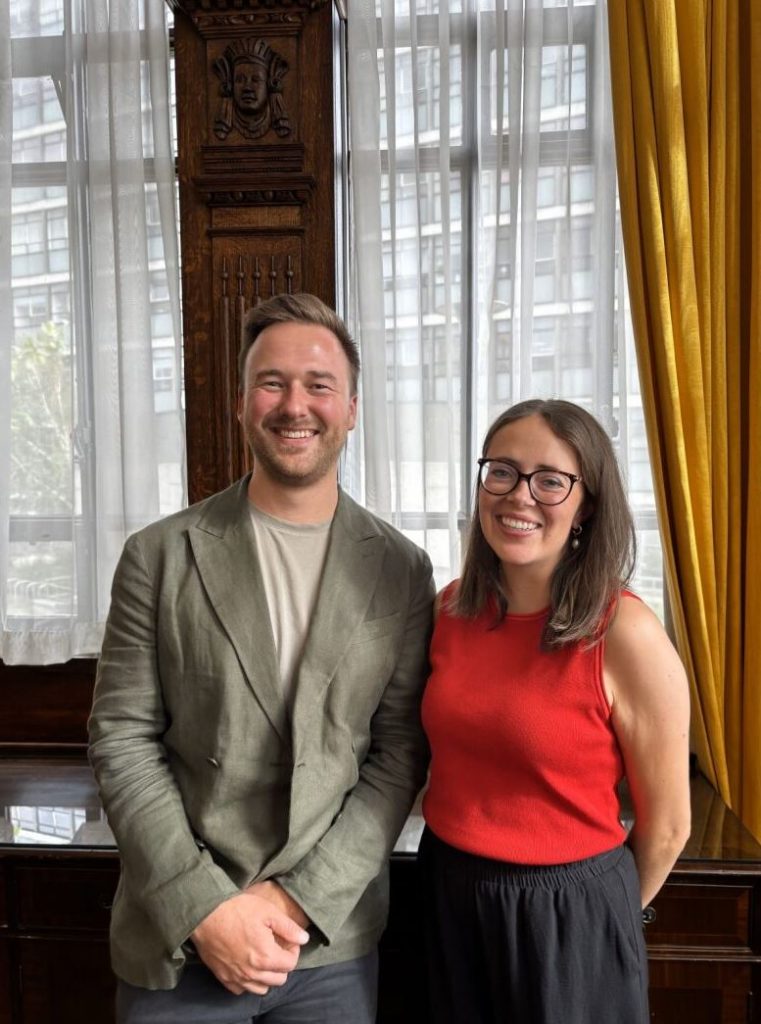
Dr Matt Cooper
Deputy-Director of EDI for the NIHR Newcastle PSRC and the Newcastle University School of Pharmacy, Research Associate in NIHR Newcastle PSRC.
I am excited to start my first full academic year as Deputy Director for EDI within the NIHR Newcastle PSRC and the Newcastle University School of Pharmacy. I hope within my role I can support Anna in her Director role and ensure that the EDI strategy is delivered in all aspects of our work. I am particularly passionate about ensuring inclusive research that is translational to practice and building a better future for everyone. The goal of the PSRC is to make real world change within patient safety for patients and the public, of which EDI is a central pillar to this work. The EDI events we will be hosting over the next academic year shine a light on this commitment as we look to learn from those making a difference with their work, inspiring the next generation of pharmacists and researchers. I encourage everyone to attend them if they can and please do reach out with future topics for our next events.
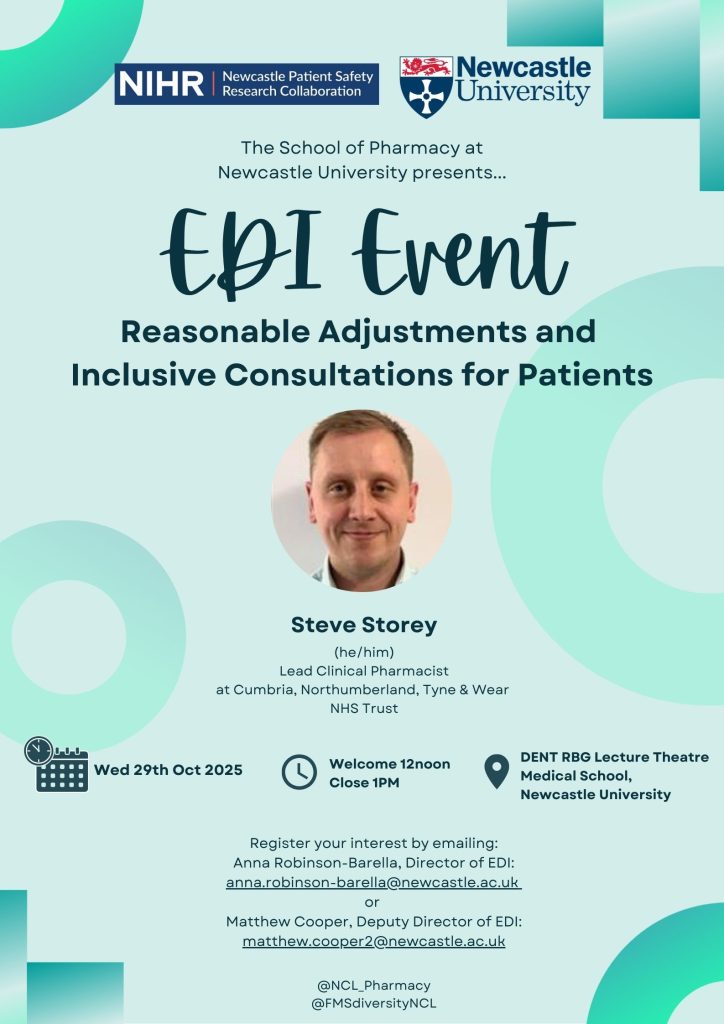
Next EDI Event – Wed 29th October 2025 at 12.00 – 13.00 on the subject of Reasonable Adjustments