

A Pre-implementation Study to develop and test an Integrated Discharge Intervention (PreSIDInt study)
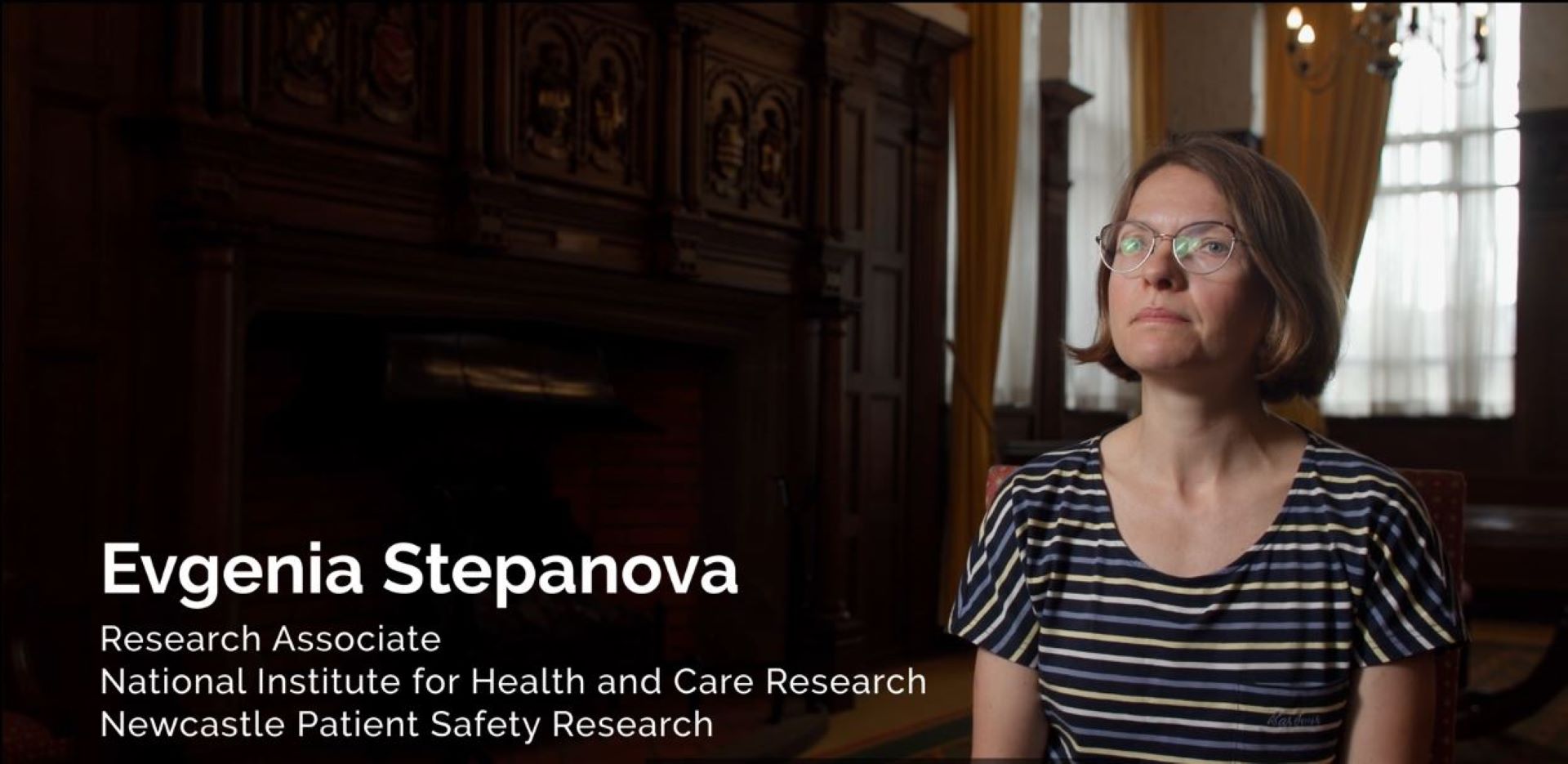
As part of a research project funded by the National Institute for Health and Social Care Research, Professor Hamde Nazar and Dr Evgenia Stepanova explore what happens to patients during the transition from hospital to home. In this video, they highlight the essential role of involving patients and the public through meaningful PPIE (Patient and Public Involvement and Engagement).
To ensure a safe and inclusive space for open dialogue, the project established two PPIE groups—a women-only group and a mixed group—each meeting four times throughout the study. These conversations offered crucial insights into real experiences of hospital discharge, revealing gaps in current research and shedding light on challenges that patients regularly face, such as feeling “in limbo”—with limited information, no clear point of contact, and uncertainty about available support.
Hamde and Evgenia reflect on how these contributions shaped the research and deepened its relevance and impact.
Programme Development Grants award NIHR205674 A Pre-implementation Study to develop and test an Integrated Discharge Intervention (PreSIDInt study)

Professor Hamde Nazar sums up the event with PPIE member, Susan Mountain.
On 11th June 2025, the first of a series of events in June focussing on Virtual Wards (hospital at home) was hosted by the Newcastle NIHR PSRC. Representatives across many of the PSRCs contributed to the planning and organisation of this SafetyNet event.
Given the increasing drive for the use of technology in healthcare, the event brought together practitioners, researchers and patient and public representatives to discuss and consider the opportunity and challenges of the use of technology to support virtual ward service delivery.
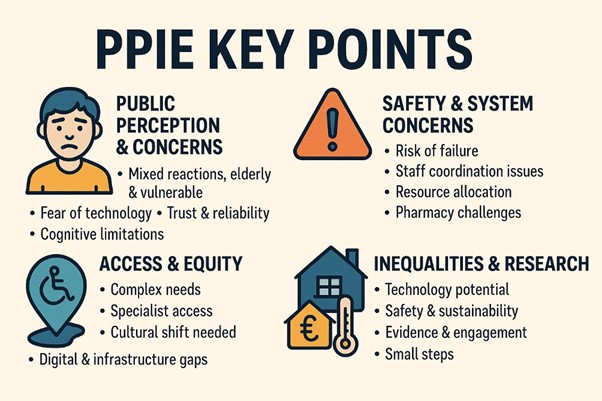
The day started off considering the patient and public voice first and foremost. The figure below summarises discussions from a patient and public involvement and engagement (PPIE) session held earlier in the year. Concerns were aired about the feasibility of technology being appropriate and accessible to all people, with other considerations voiced about the reliability of technology and trusting its effectiveness and security. People acknowledged that there are key challenges to address within the system around the workforce being properly resourced and trained, and about the existing IT infrastructure being fit for purpose. By the end of the discussion, people had ‘warmed’ to the idea, appreciating the opportunities for efficiency and potential improvements in care. However, people were keen to see small incremental developments with rigorous monitoring and evaluation to ensure people and patients were able to keep up and be reassured about the safety, equity and effectiveness of technological advancements within the NHS.
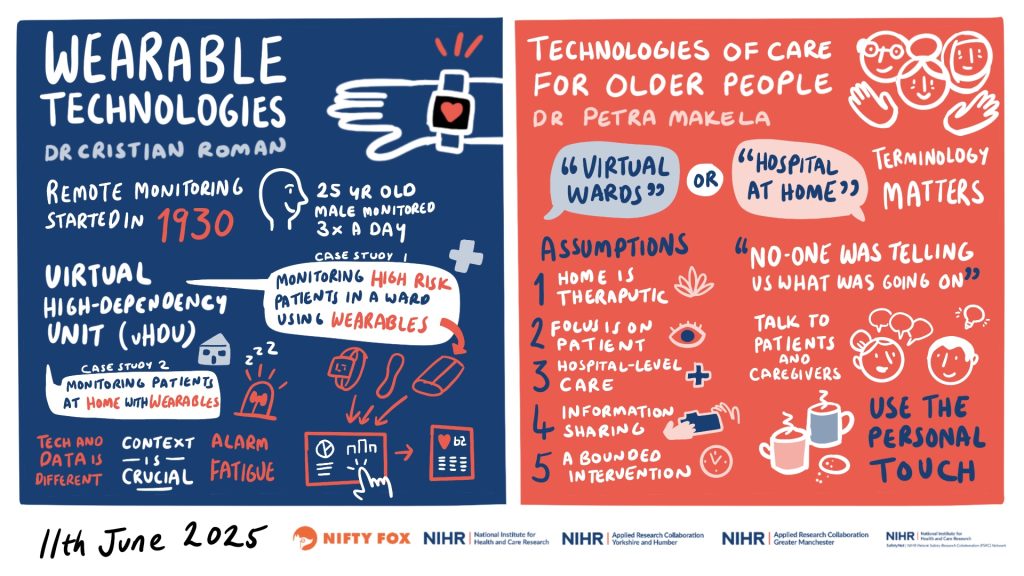
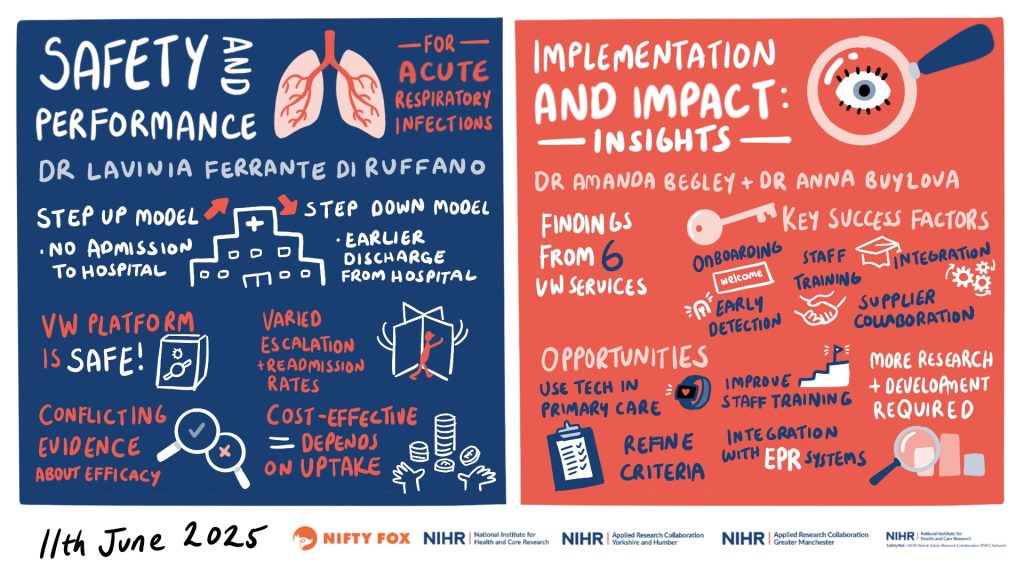
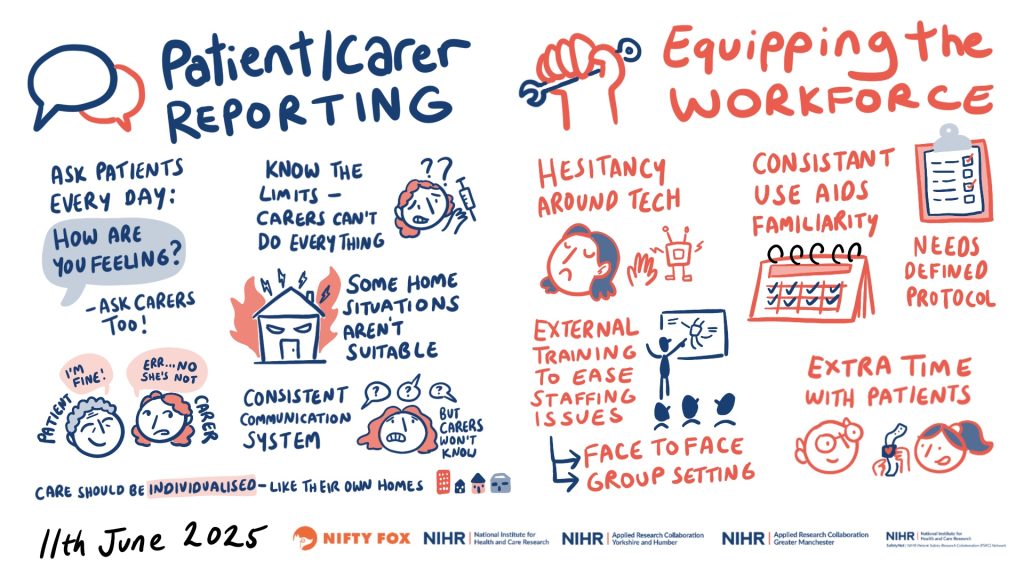
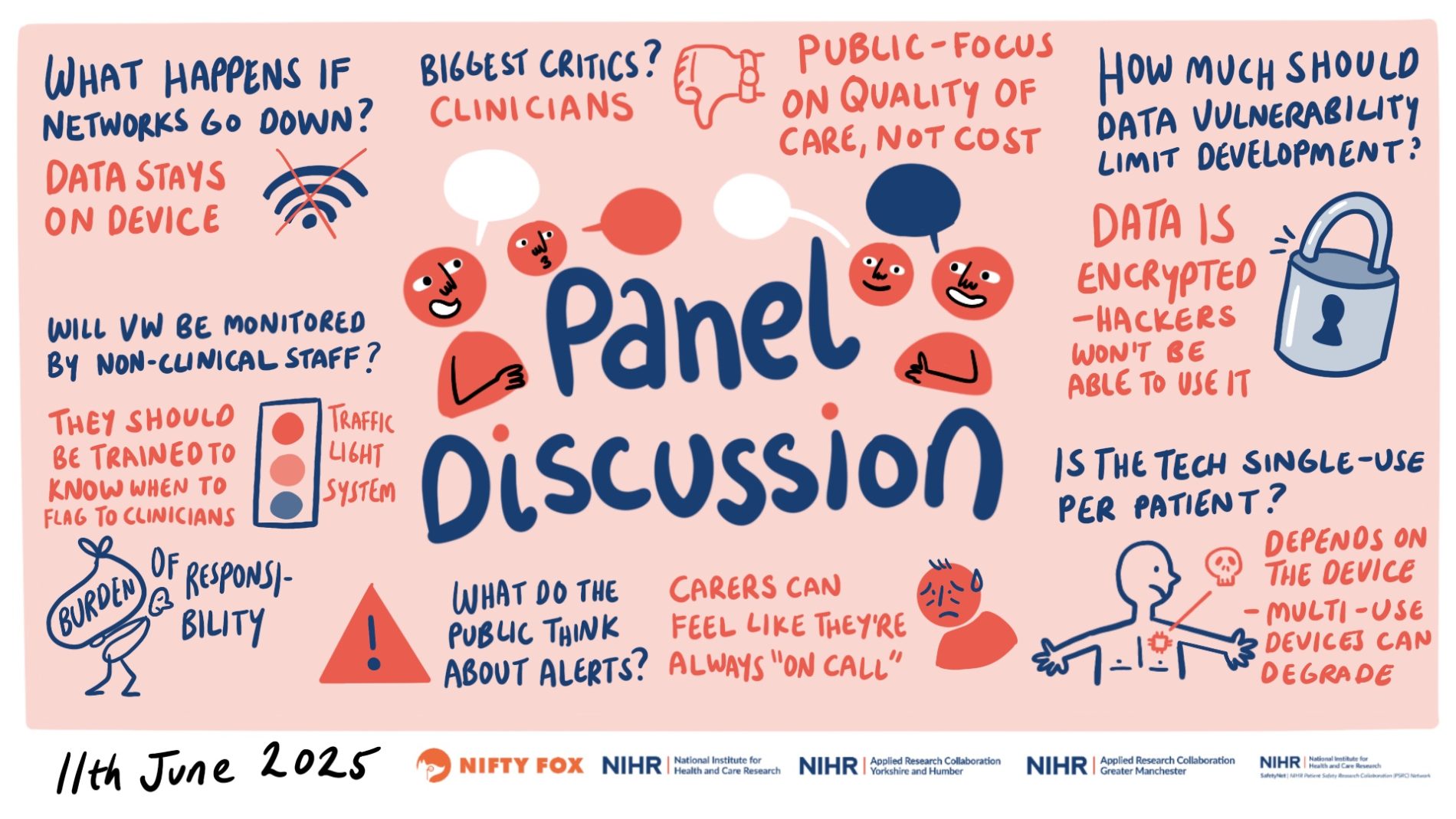
The event then included keynote speakers providing insight into existing evidence for the use of technology, with regards to effectiveness, impact on clinical outcomes and economic repercussions. These have been well captured in a series of scribes created by Claire Hubbard from Nifty Fox Creative.
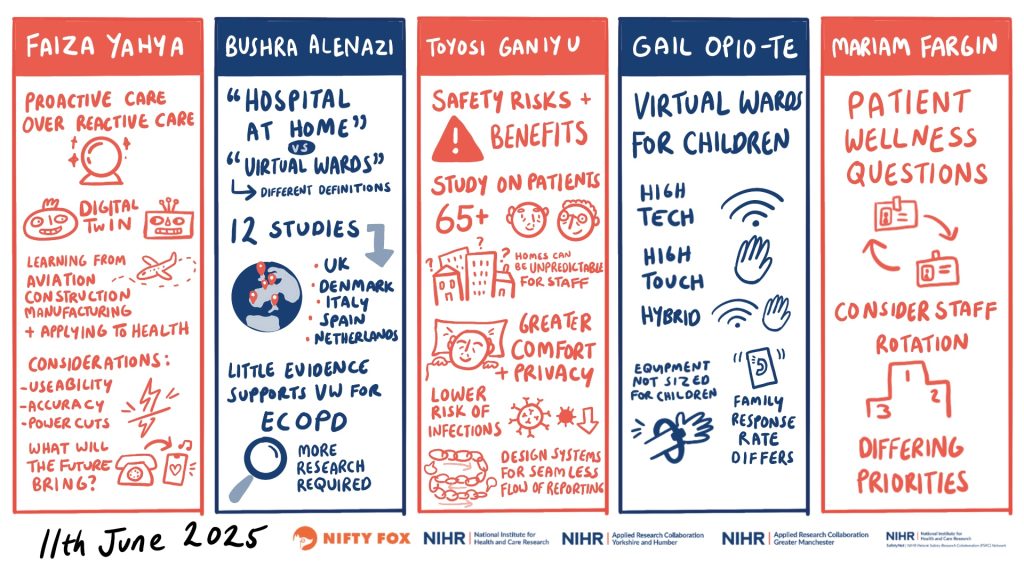
The final panel discussion saw the keynote speakers tackling provoking questions posed by the audience, e.g., ‘how do we ensure equity in technology-enabled virtual wards?’, ‘what are the biggest challenges for the implementation of technology?’, ‘how sustainable is the use of technology in virtual wards?’
There was rich debate, and we can safely say we did not go away with all the answers. Virtual ward care, and technology use in this service model is a quagmire of half-knowns and unknowns. There is need for scrutiny and evaluation of service models to understand what is working, where, how and for which patients and their carers.
The recently released NHS 10-year plan frames technology as the default mechanism to engage with health by 2035. This means trying to understand how technology is deployed and used in virtual ward care is crucial and continued resource and engagement across practitioners, researchers and public and patient representatives is needed.
On that note, one of our patient and public representatives who attended the event provides her experience and takeaway thoughts:
My name is Susan Mountain and I live with multiple long-term conditions. I became involved with public involvement in 2019 and since then I have been part of many research projects, I am a public contributor to the PSRC, AI Multiply, ARC, CNTW, Sunderland University PCPI team, a campaigner for smoking cessation and I help with the Secure Data Environment.
I attended the SafetyNet Technology Enabled Virtual Wards event and found it very interesting. I heard many people talk of virtual wards but to be honest no one really convinced me that they are currently safe. I personally don’t think they are looking at the families that are involved when a patient is sent home using the virtual ward apparatus. I am concerned that there will be too much pressure on the family.
On that note, one of our patient and public representatives who attended the event provides her experience and takeaway thoughts:
I understand that there are benefits: it reduces the pressure on hospital beds; research has shown people recover quicker in home settings and it reduces the chances of infections in recovering patients.
They talked about patients being provided with medical devices to track vital signs and that all data would be transmitted to the hospital where it will be checked at regular intervals. It did worry me if the internet stops working, then how can they monitor. I had an elderly Mam in hospital and even in hospital I had to advocate for her so what would happen if she was at home?
I believe the PSRC has an important role to play in ensuring that this is fully researched before it is rolled out. It is also vital that staff are properly trained and that there is appropriate internet access in the cases selected for treatment at home.
Blog 1
Raising awareness of the unpaid, unselfish work unpaid family carers do.
I wondered if this group was genuinely interested in involving carers in its research. I knew Tilly Hale from Liver North, a brilliant organisation where we had talks with leading consultants and I felt valued and learned a lot.
The Tilly Hale Carer research group inspires me in my own research to raise awareness of the unpaid, unselfish work unpaid family carers do. The involvement of NIHR as funders adds strength for me that the group is genuine. The group helps me to meet others like me, albeit with different reasons for caring. I feel a little less isolated and my voice is heard with this group. In hospitals, carers need a stronger sense of inclusion in decision making and being involved in the triangulation of care as they have knowledge of the patient (and possibly power of attorney).
I was a senior nurse in the NHS in Scotland and left to support a loved one. He was a brilliant academic but also an alcoholic. I have had a roller coaster journey navigating basic care at the point of need and all the horrors of alcoholism in the family. I genuinely thought he would die of injury through intoxication, or refusal of treatment from all services. I feel the patient is often consulted without the family or carer present, so the patient is often not giving informed consent.
Following my work and being part of the Tilly Hale Carer Research Panel, I am preparing a poster for a Glasgow dementia conference in May to raise awareness of the vital work carers do.
Public Contributor: Anonymous
Blog 2
Speaking openly and publicly about my experience brings some relief, knowing that health professionals and researchers want to hear the “good, the bad and the ugly” about failures of health care in the UK, is refreshing.
Hello, my name is Roy Fussey, and I’d like to share my and my wife Elizabeth’s story with you today. During the summer of 2003, Elizabeth, a long-time mental health Nurse went into work and suffered a serious assault from a sectioned patient. This assault has led to Elizabeth developing complex physical and mental health problems.
Since the assault, Elizabeth has been diagnosed with borderline personality disorder and is registered blind. She has put herself at risk, repeatedly leaving the house in an unsafe state, running towards traffic and taking overdoses. Over the years she has attempted to take her life on several occasions, abused alcohol and prescription drugs. In the years since the assault on Elizabeth, I have faced many challenging situations, many caused by her unpredictable and dangerous behaviours that often appear out of her control. Other challenges have been created by services either being unwilling or unable to provide appropriate and timely treatment and care for Elizabeth’s complex needs. On occasions simply discharging her and hoping her problems will go away.

For over twenty years my life has been a challenge and an “emotional roller coaster” at times not knowing what the next day will bring. I believe I am well placed to engage with Health Care public consultation. I have learned what works and what doesn’t. Speaking openly and publicly about my experience brings some relief, knowing that health professionals and researchers want to hear the “good, the bad and the ugly” about failures of health care in the UK, is refreshing. Being able to talk about my experiences brings some relief to me but also can be emotional and troubling.
I have been involved with several research projects with Newcastle University and involved with mental health Trust projects and staff development around carers and family members. I have considerable interest in personality disorders, and I believe it is still an area of health care that is still not fully understood or provided for. The effects on family members living with a person with complex needs can often easily be underestimated by services.
My motivation to participate in research and development is that no other person, family or carer should face the lack of understanding, empathy and failures we have faced on so many occasions. On a positive note, at the moment our lives remain difficult but stable. Brought about by consistency, understanding and empathy from services. But all this we had to fight for!
Researchers should not forget to inform all participants of the outcomes and how the research will be used.
Public Contributor: Roy Fussey
By Dr Matt Cooper, NIHR Newcastle PSRC, Safer Integrated Health and Social Care Environments Theme Research Associate.
Over the past year of the Tilly Hale Carer Research Panel, we have met on several occasions both in person and online. The sessions have been hugely beneficial to both myself and our research team. The purpose of the group was to establish a collaborative space where carers could help priorities and set the agenda for the research we are doing within the school and patient safety group. Initially I found it difficult to work out how to ensure the group made an impact and how we could become sustainable beyond the funding. I worried that the group would not have a single direction, and I wanted to ensure I brought meaning and a purpose to the group. Looking back over the past year I think the group has made more impact that I initially would have realised.
Since the group was established, I have had the absolute honour in being able to listen and learn from the experts in what caring should be about, the challenges they face, and where we need to be doing more to research to support the development of services. The carers in the group are passionate about providing the best support for the people they care for, while providing a selfless act of giving their time and energy, despite the challenges they face or the impact on their own health and wellbeing.
The group has informed my thinking and critical review of research more that I had accredited before, and they have made me think more holsitically about the research we can do. Within our research team we now have 7 projects in this space including, student carers, carers involvement in medication management, carers involvement in hospital at home care, carer wellbeing, and support for ethnically marginalised carers. All these projects I believe have been informed by the panel and give thanks to them and their openness to support this.
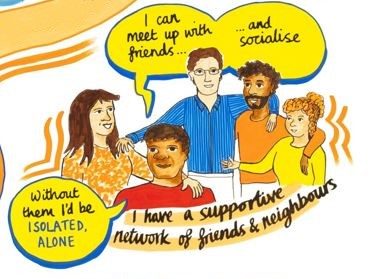
Of course, we are also working on an art piece which has been commissioned around what it means to be a carer, and below is an intial draft of this. This piece I hope can be sent far and wide to demonstrate the vitally important role carers play in the healthcare landscape and support the research we are doing. I thank the research panel for their honest reflection when developing this piece and I hope that it does justice to their experiences.

I am not a medic, nor an academic. For over 34 years, I observed and lived with someone who was constantly taking medication as he had had a transplant, then for around 20 years his health gradually changed, more conditions developed, and the number and levels of medication were a daily matter of existence. For around seven years I became a regular attendee at hospital visits, meeting consultants and learning about changes to his health, the consequences of these and the potential for enabling a good quality of life to continue. So, gradually my interest in the respective roles of patient, carer and medical practitioner grew.

Oliva Grant, Patient and Public Involvement and Engegement Lay Co-Theme Lead
“At the heart of it all, I think, RESPECT is fundamental.”
The one thing I observed was the need for listening, of all of us. My husband was the person needing the medial support but in later years I needed to be part of discussions and to understand, so that I could support him.
At the heart of it all, I think, RESPECT is fundamental. Patients know themselves and their circumstances best, academic understanding may lie with medics but each needs to listen to and consult with one another. It is not a one-way street.
During those years I did not know there was such a thing as PPIE. Learning about that came several years after his death.
In the early months of 2020, when alone at home in lockdown I was slightly ‘at a loose end’ and was approached by a senior medic at Newcastle who had spotted and cut out several cancers from my husband. He told me about the potential for joining, as a lay person, a bid for funding into the potential role for Artificial Intelligence in aiding the diagnosis of medication for people with multiple conditions. I am fascinated by the potential for AI (for good and ill) and multiple medications had been part of my life for years. So, I said yes.
There was though one condition from me to be part of this research. That the role of PPIE must be at the heart of the dialogue, researchers are not just doing this fascinating research for themselves, it has purpose. At the heart research is FOR patients, therefore patients must be integral to, listened to and heard. For that to work the researchers must be enabled to speak directly with patients, so training and enabling researchers to get this skill and ability to listen is a fundamental part of the work of PPIE. It is about being respectfully and mutually informed.
So, I would urge researchers to take up every opportunity to listen, meet and ‘hear’ what is said by PPIE members. Use lateral thought as well as deep interrogation type thinking and try to hear effectively is being said. People you are meeting are those for whom this research is directed. Essentially listen and learn, this is true both for PPIE members and researchers.
Public and patient involvement and engagement (PPIE) is a very valuable part of research, and one I have found both enjoyable and incredibly useful for planning projects and ensuring my work reflects the views of those the research is about. For my PhD project on the financial impacts of childhood illness, I have recently completed PPIE work with two youth groups in the North East – the Young People’s Advisory Group (YPAG) North East and the Youth Forum in Gateshead.
For both groups I delivered a session exploring young people’s perspectives of the barriers to young people’s healthcare access during the cost-of-living crisis (COLC). The experience I gained from these sessions working with the public and having engaging discussions has been extremely valuable for developing my skills as a researcher as well as providing me with perspectives I had not encountered in my background research.
“Incorporating PPIE into my PhD project was an invaluable experience for developing both my research itself “

These sessions revealed local and accessible healthcare, transport, dependence and family situations, negative perceptions and mistrust, and communication as six key barriers to young people accessing healthcare in the COLC.
I was able to present the findings from the PPIE sessions back to YPAG so they could confirm no important points were missed, and the work is ready to be taken forward to help inform my future research. The group were also shown a youth theatre performance of Fed Up! about child food poverty in the North East at this feedback session, allowing the young people to see both how their input will be used to inform future research as well as watch a dynamic theatre performance informed by those greatly impacted by the cost-of-living crisis in the UK.
Incorporating PPIE into my PhD project was an invaluable experience for developing both my research itself and my skills as a researcher for working with the public. It was also an experience I greatly enjoyed, and would recommend to all PhD students to build into their research.