

Experience of participation and poster presentation.
By PhD Student Rajeev Shrestha
On 18th July 2025, I got the opportunity to attend the Great North Pharmacy Research Collaborative (GNPRC) Conference, held at the Hilton Hotel, Gateshead. This event brought together pharmacy professionals, researchers, and pharmacy trainees to explore innovations in medicines optimisation, collaboration, and workforce development.
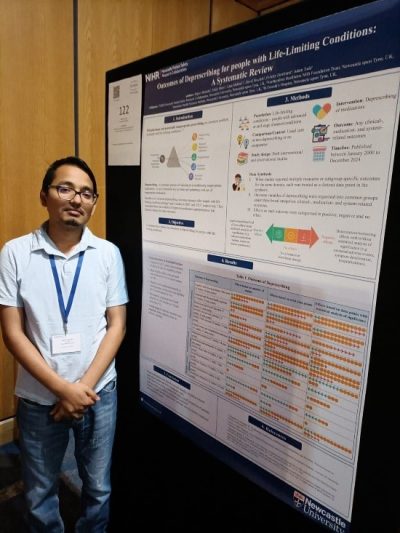
A key highlight for me was presenting my poster titled “Outcome of Deprescribing in People with Life-Limiting Conditions: A Systematic Review”. This study aimed to synthesise evidence on the clinical-, medicine and system-related outcomes of deprescribing practices among palliative patients. I had an opportunity to interact with fellow attendees during the poster viewing sessions that really sparked meaningful conversations around the safer use of medication. Personally, it was encouraging to see the ongoing works on reducing inappropriate use of medication by practising pharmacists.
The conference agenda was rich with insightful sessions. I particularly appreciated the breakout session on “Shared Decision Making and its Role in Reducing Overprescribing,” which also resonate with the area of my research. The growing emphasis on collaboration across sectors, from community pharmacies to NHS manufacturing, highlighted the evolving role of pharmacists in shaping safer, more effective care pathways.
Overall, GNPRC 2025 was a valuable experience to me. The event inspired new ideas, informed ongoing initiatives and deepened our commitment to contributing to quality use of medications.
I’m Liam, a Specialist Clinical Pharmacist in Acute and Emergency Care at Northumbria Healthcare NHS Foundation Trust. I split my time between clinical practice (four days a week) and research (one day a week) through the NIHR Newcastle PSRC Patient Safety Development Award. Since graduating from Newcastle University’s School of Pharmacy in 2022, I’ve been building my research career alongside clinical development, driven by a passion for research sparked during my undergraduate studies.

The NIHR Newcastle PSRC’s impact on clinicians
Traditionally, clinical practice and academia have been seen as separate career paths. Clinicians interested in research often had to pursue it in their own time, outside of demanding full-time roles.
The NIHR clinical academic pathway has transformed this by funding protected research time and reimbursing employers, allowing clinicians to step away from practice to pursue research.
For me, this has meant one day each week seconded at NIHR Newcastle PSRC, where I’ve developed core research skills. Working with experienced researchers has helped me understand the full project lifecycle, from shaping early ideas and designing methodology to recruiting participants, collecting data, and writing up results.
Building Collaborations
Embedding clinicians within the NIHR Newcastle PSRC helps build strong links with partner organisations. Connections with charities and local health and social care providers create future opportunities at both individual and organisational levels. This also broadens the chance for under-represented groups to have a voice, influence practice, and help reduce health inequalities.
At Newcastle University, embedded clinicians benefit from access to leading academics in their field and can learn from their experience. Previously, collaborations were often ad hoc, such as draft reviews or methodology advice. These awards now enable clinicians to work more closely with academics and gain a deeper understanding of research and academia.
Why is this valuable to the public?
Research-active organisations are linked to better patient outcomes. Combining clinical work with research lets me address real issues I encounter in practice, shaping projects that can drive meaningful change.
In acute medicine, I’ve focused on discharge and follow-up challenges. Through the NIHR Newcastle PSRC, I’m now working on a project exploring these issues for homecare recipients and those working in the industry.
Being embedded in both sectors also helps spread research findings more effectively, supporting better service improvements and outcomes.
Next Steps
A key goal is to encourage more healthcare professionals to engage in research. The NIHR clinical academic pathway supports this by offering development alongside clinical roles, leading to qualifications and national research leadership opportunities.