When “help” might harm: understanding the safety of social prescribing
Social prescribing has become a cornerstone of person-centred care, connecting people to community support, reducing pressure on services, and improving wellbeing. But what happens when these interventions don’t go as planned?
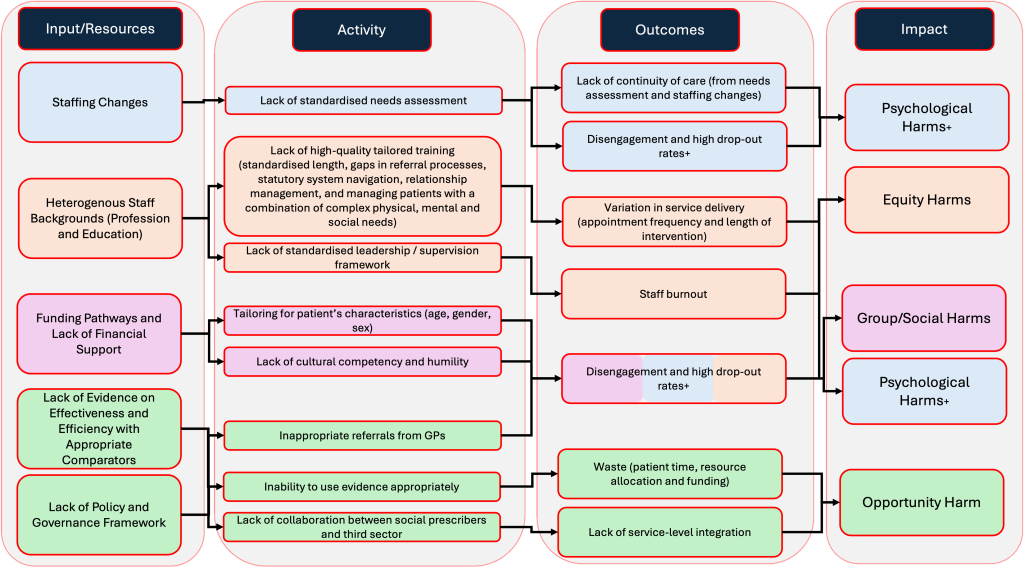
In our recent study, we looked beyond effectiveness to explore an underexamined issue: the potential harms of social prescribing. Using a global umbrella review of existing evidence, we developed a “dark logic” model (a way of mapping how unintended negative consequences might arise).
What did we find?
While social prescribing can offer important benefits, the evidence base highlights several areas of potential risk:
- Mismatch between needs and services – when referrals don’t align with individual circumstances, leading to frustration or disengagement
- Equity concerns – where access to community resources is uneven, potentially widening inequalities
- Burden transfer – shifting responsibility onto individuals or overstretched voluntary sector services
- Psychological impacts – including feelings of stigma, rejection, or failure if support pathways break down
Importantly, many of these harms are not the result of single decisions, but emerge through complex systems of care, commissioning, and delivery.
Why this matters for patient safety
Patient safety conversations have traditionally focused on clinical interventions. Our findings suggest we need to extend that thinking into community-based and non-medical models of care.
Social prescribing operates across organisational boundaries (primary care, local authorities, and the voluntary sector) which can create gaps in oversight, accountability, and follow-up. Without careful design, implementation, and evaluation, there is a risk that well-intentioned interventions could inadvertently contribute to harm.
What can we do differently?
Our “dark logic” model is not about discouraging social prescribing, but about making it safer and more equitable. Key implications include:
- Building safety considerations into service design from the outset
- Strengthening monitoring of outcomes beyond uptake and satisfaction
- Supporting the voluntary and community sector to deliver sustainable services
- Ensuring equity is a central focus in referral pathways and access
- Recognising and addressing the emotional and psychological experiences of participants
Looking ahead
As social prescribing continues to grow, there is an important opportunity to embed patient safety principles into its development. This means moving beyond asking “does it work?” to also asking “for whom, in what contexts, and at what cost?”
By bringing a safety lens to this evolving area of practice, we can better ensure that social prescribing delivers on its promise, without leaving unintended harms unseen.
Call to action
We encourage researchers, practitioners, commissioners, and community partners to actively incorporate safety thinking into social prescribing policy and practice. This includes:
- Designing services with potential harms in mind, not just intended benefits
- Sharing learning on unintended consequences across organisations and sectors
- Embedding routine monitoring of safety outcomes in evaluation frameworks
- Involving patients and communities in identifying what “safe” support looks like in practice
By working collaboratively and proactively, we can ensure that social prescribing not only supports wellbeing, but does so safely, equitably, and sustainably.
Paper link – https://bmjopen.bmj.com/content/16/5/e108998.abstract