

BOAT Trial

Information
More About The BOAT Trial
The NHS research arm is funding a national trial to help patients with bronchiectasis and their medical teams get the best out of treatments we already use. There is a trial called the BOAT Trial (Bronchiectasis Optimising Azithromycin Therapy).
What is Bronchiectasis?
Bronchiectasis is a long-term condition affecting breathing and the lungs. It can arise in adults or children and can be caused by other conditions such as pneumonia or asthma. It can also arise for no known cause. It leads to sticky mucus, irritated or inflamed breathing tubes (airways).
How does it affect people?
People who have bronchiectasis may sometimes feel worse than usual. Their breathing might get harder, their cough may get worse, and they might start to wheeze. When this happens, it’s called a flare-up or exacerbation. Flare-ups can be scary and make people feel tired and unwell.
What is azithromycin and how is it us?
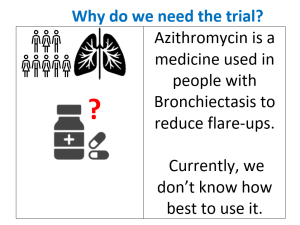
Doctors often treat bronchiectasis with a long-term medicine called azithromycin. This is an antibiotic, which means it helps fight germs. It may also help reduce swelling in the lungs by working as an anti-inflammatory. Some people take it for a long time (e.g. over 3 months) and often for years to help stop flare-ups from happening again.
This is because prior trials showed it helped reduce flare ups by 20-30%. These studies also showed that both patients taking azithromycin and those taking dummy (placebo) tablets had flare ups; overall though those on azithromycin tablets had 20-30% less flare ups.
What do we NOT know about azithromycin?
We do not know the benefits of taking the medication after 12 months as the trials of azithromycin only lasted 6 or 12 months.
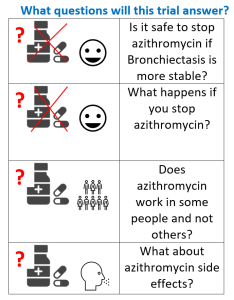
Already round the UK, some patients get a break from their azithromycin. This is because of patients’ and doctors’ concerns: long-term azithromycin can cause side effects in some people such as increased risk of deafness and sunburn.
There is also a worry that bacteria might stop responding to it if it is used too much — this is called antibiotic resistance. Importantly, azithromycin seems to cause bugs to become resistant to lots of other antibiotics beyond azithromycin itself.
Doctors are not yet sure what to do when someone’s bronchiectasis has become more stable. Should they keep taking azithromycin, or should they stop? They also do not know if the medicine works better for some people than others, or who might get more side effects.
What is the study?
To help find answers, this study will look at people (aged 16 or older) who have taken azithromycin for at least 3 months and whose bronchiectasis has been stable. Some people in the study will keep taking azithromycin, and others will stop.
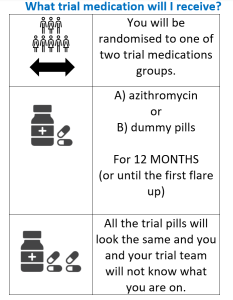
During the trial, if things are going well the volunteers will get 12 months of dummy (placebo) or active azithromycin. The researchers will then compare the two groups to see which one has fewer flare-ups, better symptoms, and a better quality of life.
The goal is to learn how to use azithromycin in the safest and most helpful way.
What does the study involve?
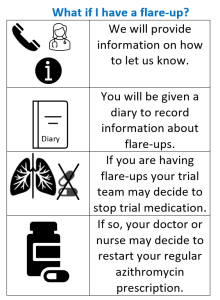
The study is designed to be simple for patients. The study has two parts: year 1 is taking the 12 months of dummy (placebo) or active azithromycin. The main thing we are measuring is how long between starting the study and the first flare up. If a volunteer feels poorly whilst taking part in the trial, they CAN STOP and ask to return to their usual tablets (e.g., restart azithromycin).
In the first year, there is one face-to-face visit and 4 follow ups. Travel expenses can be paid OR some of the visits can be done by telephone. We will ask you to complete a questionnaire on how you feel and we also ask you to complete a weekly diary. After 12 months (or earlier if you feel unwell) we stop the trial provided medication.
In the 2nd year of the trial, you are placed on whatever treatment you and your own medical team feel is right for you (go back onto NHS azithromycin or not). In year two there are two follow ups. At most you will have 1 visit and 6 follow ups (baseline, 1 phone call at a week, 3 months, 6 months, 12 months, 18 months and 24 months).
Are there lots of blood tests and breathing tests?
NO; the study can be done with none of these if that is your preference. If possible we would like one blood test at the start and a breathing test (same as usually done in clinics at the first visit – none are taken for the trial after this visit).
Do I have to attend the trials centre when I’m having a flare up to be checked out?
No! the study is designed to be very simple. When you think you are having a flare-up, you make your own decision to start treatment (or see your GP for this). All we ask is you complete a weekly diary collecting information “Yes” I have been poorly and started treatment for a flare up or “NO” I’m pretty well for me and haven’t needed treatment for a flare up.
Why is the study important?
Currently across the UK, patients living with bronchiectasis are treated with azithromycin as we know it works over the short term. This was shown by patients volunteering to help in studies. We do not know how long the benefit lasts for and if some patients can have a “holiday” from the medication. Already many patients have 6 months on and off. We are now asking patients on the medication to enter the trial to help avoid us using the drug in patients who don’t need to stay on it and help reduce side effects and resistance.
About Us
Meet The Team
Professor Anthony De Soyza
Chief Investigator, Professor of Pulmonary Medicine
Dr Lauren Selfe
Project Manager
Hiranmayi Madabhushi Hari
Research Associate (SWAT)

Keep Up To Date
Updates and Newsletters


Learn More